
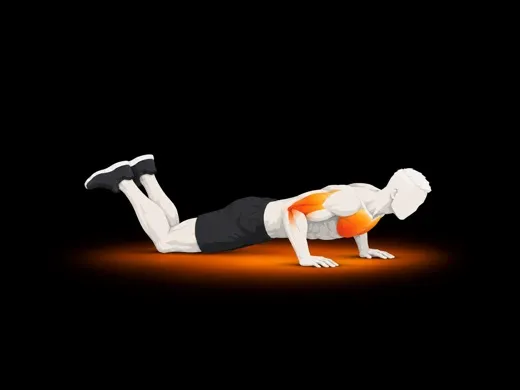
You can start calisthenics before you can do a floor push-up or pull-up. Begin with two full-body sessions each week, choose versions of movements you can control, and keep the plan simple enough to repeat. A third day can come later if you want it. The CDC recommends muscle-strengthening activity on at least two days a week; the American College of Sports Medicine’s 2026 guidance also emphasizes training major muscle groups regularly and building gradually.
What a beginner session needs
Think in movement patterns rather than a long list of exercises: something to push, something to pull, a squat, a hip movement, and some trunk work. You can train these at home, but pulling needs a safe setup such as a properly anchored resistance band or a suitable pull-up bar. Do not rely on a makeshift door, towel, or furniture anchor that may slip.
Pick a version you can perform with control. An incline push-up counts as a push-up variation. Sitting down and standing from a chair is a useful squat starting point. Your first session does not need advanced skills or a race against the clock.
A sample full-body session
Start with a few minutes of easy movement: walk around, move your shoulders, and do a few comfortable sit-to-stands. Then try this circuit at an unhurried pace:
- Wall or incline push-up: 6–12 controlled repetitions.
- Sit-to-stand or bodyweight squat: 8–12 repetitions.
- Resistance-band row or assisted pull-up: 6–12 repetitions using a secure setup.
- Glute bridge: 8–12 repetitions.
- Dead bug: 6–10 controlled repetitions per side.
One round is enough for a first attempt. If the movements feel comfortable and your form stays steady, do a second round. Rest long enough to perform the next set well. The numbers are an example for a healthy beginner, not a test you must pass. The CDC’s strength guidance describes 8–12 repetitions and one set as a useful starting point, with more sets as an option.
If you do not have safe equipment for pulling, leave that movement out for now and plan to add a suitable band or bar. A no-equipment workout can still get you moving, but it does not fully cover pulling strength.
Your first four weeks
Week 1: Do the sample session twice, with a day between sessions. Use one round if that is plenty. Learn what each movement feels like.
Week 2: Repeat the same movements. Add a second round where you can keep the same control. You do not need to make every exercise harder at once.
Weeks 3–4: Keep two sessions, or add a third if the schedule feels sustainable. Add a repetition to a movement when it feels manageable, or choose a slightly harder version. If form breaks down, return to an easier version. Starting gently and increasing activity over time matches CDC guidance.
This is a sample routine. Your starting point, available equipment, and recovery may call for different exercises or a different amount of work.
How to know what to change
Write down the exercise version and the repetitions you completed. On your next session, try to perform it with the same or better control. Change one thing at a time: another repetition, an extra set, or a slightly harder variation. You do not need a dramatic jump to make progress.
Kalstheno starts with an assessment and builds sessions around your level, goal, equipment, and time. The app handles those choices as you train; the example above is simply a place to begin.